

Whether you live somewhere sunny, or are planning a beach trip with baby soon, you may find yourself wondering what the heck to do about babies and sunscreen. Maybe you’ve heard it’s not allowed under 6 months, and you’re confused how to keep your little one safe.
I’m here to clear it up, and give you a recommendation for our absolute favorite brand after years of baby and toddler sunscreening.
Please note that I am not a medical professional, but I will share what our pediatrician recommended alongside AAP guidance, as well as my experience as a mother of two very white babies who LOVE the sun. This is in no way a replacement for having a quick check in with your pediatrician about the topic!

What do doctors say about sunscreen for babies?
The American Academy of Pediatrics had long recommended that babies under 6 months not use sunscreen. They’ve updated their wording, which I will get to in a second. But what was their reasoning?
The problem has never been that sunscreen is harmful, but rather that it is not enough. Babies under 6 months have extremely sensitive skin, and a sunburn for a baby is particularly harmful… not to mention miserable for baby! Any sunscreen for a child under 1 year old warrants a call to your doctor. The AAP recommends that under 6 months, babies stay out of the sun entirely, thus eliminating the need for sunscreen.
According to the AAP, your baby should be in shade or wearing fully protective clothing 100% of the time. This is solid advice, but not always practical.
They do now state on their website that sunscreen should be used on babies under 6 months if protective clothing and shade are not available.
YOU MIGHT ALSO LIKE
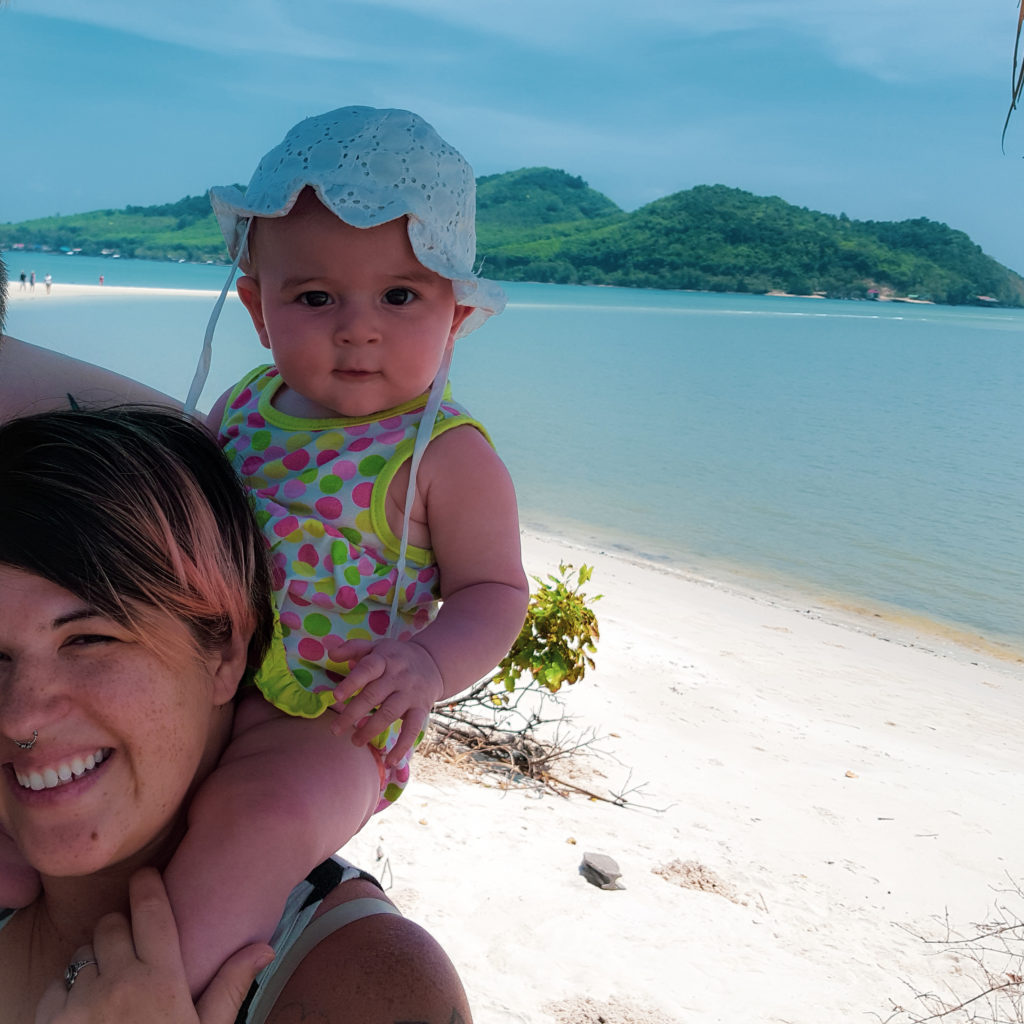
When we were getting ready for our very first trip with a baby – 3 weeks in a very sunny Thailand with a 4-month-old – we asked our pediatrician about this, because at the time the official recommendation was no sunscreen. She recommended that we do use sunscreen, but that our primary focus is on shade, with sunscreen as a back-up. She recognized that it is not always possible to ensure that we’ll be in shade, especially while traveling, and that we should have sunscreen on our daughter just in case.
Along with this, of course, she said we must use a sunhat (read about my two very favorite baby sun hat brands!), and protective clothing as much as possible. But when going to a climate significantly hotter than our own, we knew long sleeves and pants were probably going to be a tough sell. We needed sunscreen.
She also recommended that we use a physical barrier sunscreen, which I will discuss more below. I was so thankful for her recommendation, because while there were times that we were unable to be in shade, our daughter did not get even the slightest bit of sunburn during that trip.

What kind of sunscreen to use for babies?
The most effective type of sunscreen for baby (or anyone else) is a physical barrier, aka mineral, sunscreen. This is a sunscreen that creates a physical barrier on your skin, keeping the UV rays out. The alternative is a chemical sunscreen, which actually absorbs the UV ray before your skin soaks it up. Both work, but physical sunscreens are effective against a broader spectrum of rays.
Physical sunscreens are also gentler on the skin, and dermatologists typically recommend a particular subset of physical sunscreens for anyone with sensitive skin, including kids and especially babies: zinc oxide sunscreens. The AAP agrees, stating that for children, a zinc oxide or titanium dioxide sunscreen should be used on sensitive areas of the body, like the face.
Here’s the kicker, though… All those super convenient spray sunscreens? Yeah, those are chemical sunscreens. Physical barrier sunscreens are the goopy white stuff. And zinc oxide, especially, can be tricky to spread.
Look, it is going to take you a little longer to sunscreen your baby with a zinc oxide sunscreen. But it is 100% worth it, because you are getting the best protection (short of staying completely in the shade).

A little personal experience here: my kids are getting a bit older now. 4 and 6 to be exact. We’ve made the switch from our favorite baby sunscreen to sprays for their body. We still use baby sunscreen on their face. Our reasoning? It takes FOREVER (and a full tub of product) to zinc oxide a 6-year-old all over her body, and spray takes about 1 minute. Their skin is not as sensitive as a baby’s, as evidenced by how tan they get now. And when they get slight sunburns (which they sometimes do), they can cope better than a baby.
But that’s just it… they do get sunburns. Not severe ones, because we are diligent about re-sunscreening every 2 hours. But we just returned from Tahiti, and both of them dealt with sunburns on their shoulders and backs, no matter how careful we were.
But you know what did not burn? Their faces. We continue to use baby sunscreen on their faces, because kiddo facial skin is still so sensitive. And the difference between their arms – sunscreened every 2 hours, and their faces – sunscreened twice per day, is pretty crazy.

YOU MIGHT ALSO LIKE
What is the best baby sunscreen?
So we know that we want to use a zinc oxide or titanium dioxide sunscreen, but which one is the best? We’ve used a lot over the years. Sometimes because we don’t plan ahead and end up with whatever we can find at the drug store before we leave, sometimes we have to buy any sunscreen we can find at our destination (which is always bad and typically super pricey), and sometimes we try to branch out just to see what else is out there. But we always come back to the same brand: ThinkBaby.

We love ThinkBaby because, of all the zinc oxide sunscreens we have tried, it goes on the smoothest. It rubs in nicely and doesn’t look quite as ghostly as most others. And, above all else, it just works. Neither of my children have ever burnt even the slightest with it on. We’ve literally been at the beach all day without reapplying, without a burn. (Although I don’t recommend that… you really should reapply as needed throughout the day!)
ThinkBaby is completely non-toxic and designed with babies in mind. All of the ingredients are safe, even if your baby ingests it. And considering that babies tend to put their arms and legs in their mouths often, that is some serious peace of mind.
An additional consideration that matters to us is that ThinkBaby is reef safe. We tend to travel to lots of tropical places, and we are well aware of the damage that sunscreens do to coral reefs. Non-nano zinc oxide is considered the best option for coral reefs. Non-nano refers to the size of the particles, and is also sometimes called micro. Nano-particles are more harmful to reefs, even if they are zinc oxide.
ThinkBaby is non-nano, and they do not add any other ingredients that are harmful to coral. In fact, their grown-up version, ThinkSport, regularly tops lists of the best reef-friendly sunscreens.
I also love that they sell 3 oz tubes. This is perfect if, like us, you travel carry-on only. Stick a few of those in your carry-on bag and you are good to go!
Some tips for baby sunscreen
Now that you’ve got the best baby sunscreen, here are a few tips that we’ve learned over the years to make it easier to deal with.
Consider a makeup brush for application.
Honestly, we never used this, but it actually is pretty genius. We have a few friends who swear by this. It will rub on so much smoother, spread easier, feels nice for baby, and you don’t end up with it all over your hands. The only reason we didn’t use this tip is because I discovered it a little too late for us, and now since we only apply to our kids’ faces, we haven’t bothered to buy a brush.
Apply it to yourself as well.
I don’t know about you, but my babies liked to chew on me. Whether it was my hands, my shoulders, or missed attempts at breastfeeding, anything on my skin was likely to end up in my baby’s mouth. Keep that in mind as you think about your own sunscreen. For body parts that are likely to end up licked, a baby-safe non-toxic sunscreen is probably the best choice.
Apply sunscreen before going out, even if you are not planning to spend much time in the sun.
Keep in mind that sunburns can happen in as little as 10 minutes, so even if you are not planning a beach excursion, you may want to preemptively apply sunscreen for any outing. If you are traveling, things often don’t go exactly as planned and you never know when you’re going to end up standing around outside unexpectedly. Best to always apply a layer to exposed skin before you head out, and keep it with you in your day bag.
So many new parents wonder, can you put sunscreen on a baby under 6 months? Hopefully this helped clear up some of the confusion. And while my family absolutely swears by ThinkBaby, any high quality zinc oxide sunscreen is best for baby.








1 thought on “Babies and Sunscreen: What You Should Know + the Best Baby Sunscreen We’ve Tried”
Hi Dani!
In a couple of weeks we are travelling to Thailand for a month with our then 8 month old. I was wondering if you have any recommendation for insect repellents for babys?
I am an experienced backpacker but this is our first vacation backpacking with a baby. Thank you very much for demonstrating that it is possible to travel light, even with a baby and a toddler!
Greetings from Germany!