

Anybody who has ever dealt with jet lag in babies knows that it can potentially cost you several days of your vacation. A jet lagged baby is right up there with food poisoning on the list of ways to completely ruin a trip.
And rightfully so. Jet lag sucks. It’s one of the toughest elements of travel. You feel tired, groggy, sometimes nauseous, headaches… It feels awful and impacts everything you do. Imagine being too young to understand why you feel so icky, and just wanting it to go away. That baby doesn’t care what fun activities you had planned for today – that baby wants to sleep.

Can babies get jet lag? Absolutely. So let’s talk about everything that you can do to prevent baby and toddler jet lag, and what to do if you’re already in the middle of it.
Is it better to fly at night or during the day?
I have to start with this question, because it is the one thing that every parent wonders. While some people have a strong preference one way or the other, the truth is there is no right answer when it comes to preventing jet lag with kids. What works for one kid for one trip will not necessarily be what is best for them next time.
There are a few factors you can consider as you weigh this decision, though. I, personally, cannot sleep on planes. I might get a half hour here or there if I’m lucky. For that reason, I don’t like to fly overnight. On the other hand, we only have so many days off from work, and flying overnight does help to lessen the impact of days missed, rather than wasting a day of awake time on the plane.
I have had a red-eye flight with baby go terribly wrong. When your toddler does not sleep at all (or very little) on an overnight flight, it is a disaster to try to recover from – not to mention incredibly stressful if you’re falling asleep on the plane but your child isn’t. It took many days to recover from one terrible overnight flight when we took our almost-2-year-old to Italy. We had to cancel a lot of our plans for that trip.
I have also had red-eye flights with babies that worked just as they should, including our most recent trip, to Vietnam. The toddler slept through the night. The baby slept through the night. The husband slept through the night! I… got a couple hours of sleep. But it didn’t matter – I was thrilled to have well-rested children when we made it to our layover.

For shorter flights (under 8 hours) with less of a time change, I really prefer daytime flights with very young children. I would rather lose a day, keep them entertained and playing the whole time, and be in a better place in regard to baby jetlag for the whole trip.
YOU MIGHT ALSO LIKE
For super long flights with major time change, I prefer to bite the bullet and attempt the overnight flight. Sleep is going to be all messed up anyway, so just do whatever you can to mitigate.
Speaking of which, here are all of the tips that I’ve accumulated over the years to help deal with jet lag in babies and toddlers:
Before the flight
What is the 1:1 rule, and should I follow it?
The 1:1 rule is the idea that it takes 1 day to recover for each hour of time difference. Some people say you should plan for easy days for the whole 1:1 time. I think this is BS, honestly. A 1-hour time change does not require a recovery day. And if you follow this rule for a long-haul flight, you might spend your whole trip on “recovery” days!
Our most recent family trip was from Seattle to Vietnam. That’s a 14 hour time difference. We certainly felt the effects of jet lag for the first several days, but we did everything we could to mitigate the effects of jet lag so that we were all feeling 100% within a week (and definitely good enough to fully enjoy our trip within a couple days).
In addition to the crazy time change, that was also 17+ hours of flight – not including the layover – just to get there. Long haul flights with a baby are not that bad when you know how to prepare for them!
Start to make the time change adjustments a few days ahead of time.
You can take some of the pain of the time change away by spending a few days working up to it. If you are traveling eastward, start going to bed a bit earlier than usual before your trip. If you are traveling westward, start staying up a bit later. This goes for the baby or toddler, and for you as well!
By taking on a bit of the burden before you leave, you will have it a little easier when you arrive.
Take the guesswork out of fixing your schedule.
Managing time change math can be challenging, especially when you’re already sleep-deprived. Consider downloading an app before your trip that will give you reminders about when you should be sleeping and waking while on your trip. Timeshifter and Entrain are two examples.
There is no guarantee that you will be able to follow the schedule as prescribed, but it can be helpful once you’ve landed to keep track of the best-case-scenario for sleep and strive to achieve it.
Get good sleep on the nights leading up to the trip.
It is very important that your little ones get the best sleep possible leading up to the trip, because tiredness will make jet lag worse. If you will be flying during the daytime, it is essential to get good sleep the night before so that kids can stay awake during the flight. Be sure to plan for how to keep them entertained for daytime flights as well!
Run out some energy before the flight.

This applies whether you are flying at night or during the day. Either way, your child is about to be restrained in a small space for several hours – you need to burn off some fuel. Exercising before an overnight flight can actually help you to sleep better!
Run around the airport. Find and take advantage of the children’s play areas. Have your toddler walk instead of ride in the stroller. Try to ensure that you get to the airport far enough advance of your flight to make time for exercise to help prevent toddler jetlag.
Stay well hydrated.
This applies for the hours leading up to the flight, the duration of the flight, and afterward. Dehydration has a significant impact on jet lag, amplifying the effects. Come prepared with plenty of water, milk, juice – whatever works for your baby.
Remember that you can bring milk, breastmilk, and juice through airport security in any reasonable amount if you are traveling with a baby or young toddler. Be sure to remove it from your bag and declare it to the security officer before you go through security.
You can get water and juice on the flight, but they never have milk available. Bring plenty extra of whatever you need.
Tip: if you don’t want to deal with a cooler, try bringing shelf-stable milk boxes!
Keep yourself hydrated throughout the flight, as well. Ask for extra bottles of water. Yes – you’ll need to use the bathroom more often which is challenging when you’re traveling with babies, but it is worth it to help prevent the worst of the jet lag.
During the flight
Set your watch at the beginning of the flight.
Whether that means your actual, physical watch, your cell phone, or just your mental model – once you sit down on that plane, put yourself into the time zone of the destination.
This will help you get in the right mindset, it will ensure that you’re thinking properly about when your kid should sleep and eat, and it will help you start to adjust to all the changes.
It is helpful to even start to get into this mindset before the flight. Throughout the day leading up to the flight, do a quick mental check-in for what time it is in the destination.
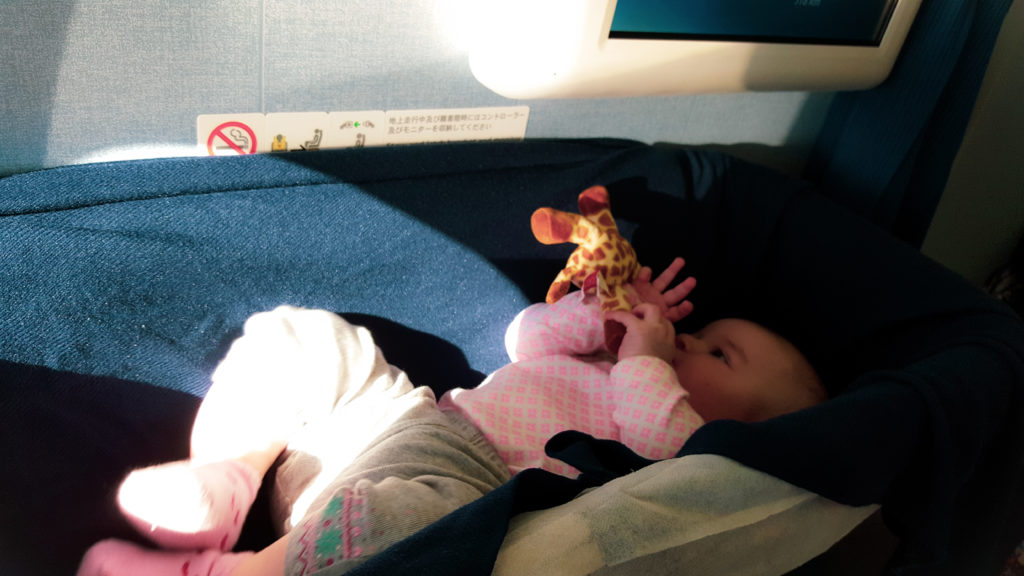
Consider getting the bassinet seat.
The airplane bassinet. You either love it or you hate it, and it depends 100% on the experiences that you’ve had.

I personally LOVE the bassinet, and request it every time if my littlest is within the weight limit. The weight limits vary dramatically, by the way. On one flight, our 4 month old was barely within the limit. On another, our 12 month old was good to go. Each airline will have their own rules, and the bassinet itself can vary widely from plane to plane.
The upside to the bassinet is a cozy place to sleep that is not a car seat. For babies who don’t sleep as well in the car seat, or for a trip that you are not bringing the car seat, this is a great option.
You also don’t have to purchase the baby his or her own seat to use the bassinet! It is for lap infants. You can of course request it and buy a seat if you choose.
There are some downsides. For one, you might not be guaranteed to get it. The bassinets are located in the bulk head rows, and those seats will be given as priority to travelers with disabilities and then to families with babies. There are usually more than enough spots, but it is a real possibility that you’ll expect a bassinet, but end up with a lap infant.
Some people don’t like being in the bulkhead seats – you have to stow all of your stuff for take off and landing, and you’re close to the bathrooms. I personally love being in the bulkheads – we spread an airline blanket on the ground and set up a little play area for the kids during awake times.
The other risk with the bassinet seat is that the stewardesses might make you wake the baby if there is a risk of turbulence. I’ve never once had this happen, and we have used the bassinet many times. The baby gets strapped into the bassinet (sometimes with a cushioned 5-point harness!), so I’m not sure why some airlines think it will be safer for me to hold the baby if there is extreme turbulence, but okay.
Nevertheless, I have heard several parents complain about flights where they had to keep taking the baby out of the bassinet, and that really defeats the goal of getting uninterrupted sleep.
For what it’s worth, I will always advocate going for the bassinet.
Bring healthy, filling snacks for the flight.
Healthy food is an important part of keeping your baby or toddler feeling good and helping them sleep at the right time. Unfortunately, you just can’t count on the airline to have the right kind of food.
Often, the only snacks available to buy between meals are loaded with sugar and lacking any nutritional value – making them the worst choice for a baby who needs a full tummy to get some sleep.
I always bring healthy pouches for the flight. I like the ones that have a solid amount of protein to help the baby feel more full, versus just a pouch of applesauce. Long after I’ve stopped using these at home for my toddler, I still bring them for the flight because they are easy!
Declare these as baby food when you go through security. Even with a toddler.
If you are doing an overnight flight, do everything possible to help them sleep.
Does your child sleep well in the car seat? Then I would recommend bringing it along. (I actually recommend that regardless, but especially if you know they will sleep better than on an airplane seat!). Bring a favorite blanket and lovey for the flight – they will help at the destination, too. Have some books for your child to look at before “bedtime” just like at home.
If you are nursing, take advantage! Time it so that you will nurse around the time that you’d like to have your baby fall asleep.
Be wary of using electronics shortly before it is time to sleep. Just like at home, blue light from a screen can cue the brain to stay awake. It should be avoided for the last hour before sleep.
My toddlers love their CozyPhones headphones (see my full review of CozyPhones here). Even if they are not watching a show because it is getting close to sleep time, I still have them keep them on. They can listen to music, which I might change to get calmer and calmer. Cozyphones are great to fall asleep in, and will help to muffle any sounds of the people around you.

Take stretch breaks when possible.
This is especially important for daytime flights that you want your child to be awake for. I love keeping my kids contained in a car seat for the majority of the trip, but every now and then they need to get out and stretch those legs.
Take a walk (together!) around the cabin. Hang out in the areas outside of the bathrooms. Play some kicking and stretching games in a space where they won’t be kicking the seat in front of them. Just please don’t let them run around the cabin unsupervised – that is very disruptive to other passengers!
People will understand that little legs need to move, and as long as you are there with your child, no one will mind if you’re walking up and down the aisle for a few minutes in the middle of a long-haul flight. Or if they do mind, that just means they are out of touch and it’s not your problem. But no one has ever given me any grief for this.

Try to rest when they rest.
Even if it might not be the moment that you are most tired, try to get some sleep when your little one does. It’s just like having a newborn again, right? Nap when baby naps.
It is going to be imperative to get on the same sleep schedule as your child after you land, so you might want to start with the flight. If you reach the point of exhaustion right when your toddler is waking up from a 6-hour stretch of sleep, nobody wins.

YOU MIGHT ALSO LIKE
After the flight
Get in step with your kid’s sleep.
While it is important to adjust your sleep schedule to the new time zone, it is even more important that you adjust to whatever it is your kid is doing.
You might not have success right away getting your baby adjusted, even if you can manage to get adjusted yourself. And that is not going to help you one bit.
If your little one is going to bed at 6pm and waking up at 3am, you need to make sure you’re going to bed super early, too. Because you’re getting up at 3am either way.
You will work on getting your child closer to the right bedtime over the course of a few days – don’t worry too much about it right out the gate. It is most important that the whole family is in sync with your sleep schedules, and that probably means everyone has to adjust to the youngest family member’s needs.
Plan a very relaxed first day.
Whether you are getting in at night and (hopefully) sleeping before your first day, or getting in sometime in the morning after (hopefully) sleeping on the flight: plan to take it easy.
When you travel with kids, you can’t hit the ground running. Don’t plan any amazing excursions for the first day. Do plan to get outside, though! Natural light is the best remedy for jet lag, because jet lag is really the disruption of your circadian rhythm. Light – especially sunshine – helps your body figure out that it’s daytime, and you should be awake. A day at the local park is a perfect first day plan.
The second day could also be pretty dicey. Make sure anything that you put on the itinerary for the first 2 days would be okay to cut if needed.

We had to do this on our 3-day layover in Amsterdam on the way to Italy. We messed up the flight badly (let her stay awake watching shows when she should have been sleeping), and as a result, she had severe baby jet lag. We had to throw our entire Amsterdam itinerary out the window, because our jetlagged baby was awake from 8pm until the morning, and then slept all day. We were stuck in the hotel room the whole time, and it sucked.
We slowly got her adjusted a bit earlier, to where we were able to wake her in the afternoon so we could at least get outside for a bit. We had a good walk through the zoo our last day before flying on to Italy, and that outdoor time in the sunshine made a huge difference, and the next day was significantly better.
I was sad that we missed everything that we had planned for Amsterdam, but I learned a valuable lesson about the importance of preventing jet lag for toddlers.
Keep little ones awake until evening time for the first day.
Try to keep everyone awake until at least the evening for your first day there, no matter how tired you are. It will help tremendously if you can get a semi-normal night of sleep, but that’s not going to happen if you turn in at 2pm.
Getting outside can really help with this. Not only will the natural light cue your child’s body to align with the time zone, but your child will have a better chance of staying awake if you’re somewhere fun like a park. Sunshine really is one of the best toddler jet lag solutions!
Of course, this does not mean to skip a nap. Try to time the nap well, and don’t let it go more than 2 or 3 hours. If your child decides to go down for nap in the few hours before bedtime, just count it as an early-than-hoped-for bedtime.

Adjust by a few hours each day.
If you are dealing with many hours of time change, try to adjust a few hours each day. That means either going to bed an hour or two earlier or later than the day previous. This is harder with little children, so even adjusting by 1 hour per day will help.
I have found that this gets easier after the first couple days, as everyone’s bodies are more ready to adjust because of the time spent outside in the sun.
Make sleep as comfortable and familiar as possible.
When it is time to sleep, you want to do everything possible to help your jet lag baby fall asleep and stay asleep.
For babies and toddlers, a lot of that comes down to familiarity.
Remember how hard it was to train your baby to sleep in his crib? Or how about that switch to the toddler bed? You can’t expect that suddenly sleeping in a new room, in a new crib or pack n play, is going to be easy.
For this reason, I am a firm believer in toddler travel bed training. I spent the month prior to our trip to Vietnam getting my 1-year-old comfortable with sleeping in our Joovy Gloo. And it worked! She had a familiar, comfortable space to sleep at night that looked the same from the inside no matter what room we were in.

We only had to battle with baby jet lag – we did not have to compound it with a baby who was scared and out of her comfort zone. This meant she was able to fall asleep right away when she was tired, and if she woke up in the middle of the night, she did not freak out. This was a huge part of our success overcoming her jet lag.
Don’t forget to bring a favorite blanket (if your baby is old enough, of course), a lovey, and anything else they sleep with at home. Download a white noise app on your phone to drown out any hotel sounds.
Start adjusting back the other direction a few days before the end of your trip.
You’ll be dealing with jet lag on your way home, and it’s a lot less fun when you don’t have a big adventure to look forward to each day.
Start adjusting back the other direction a few days before you fly home. All that work to adjust to the new time goes out the window! Reverse direction and plan to do this all over again.
Other considerations
Take care to prevent your own jet lag, as well.
It’s no use having a reasonably jet lag-free child if you feel miserable and can’t stay awake during the day. Look out for your own health, as well.
Many of these tips will carry over (albeit somewhat simplified) for the whole family. Additionally, take care with how much caffeine you use and when, take it easy on the alcohol during the flight, turn off your own screen when it gets closer to sleep time, and try to get rest while your child sleeps.
Don’t use sleep aides on the plane if you are in charge of the baby!

Consider staying in your home time zone, or only adjusting partway.
If you don’t really have to switch time zones… don’t! It is way easier on kids if you are not trying to force them to go to sleep earlier or later than their body wants to. You could still be dealing with some baby jet lag symptoms like over-tiredness, nausea, and headaches, but sticking with the internal clock will help.
For example, let’s say you are flying from NY to CA. If your toddler normally goes to bed at 8pm, you would move their bedtime to 5pm in California time. Get some black-out shade curtains.
This is best if you are going for a short (less than 1 week) trip, have a small time change, and have flexibility with your schedule during the trip.
You can also meet somewhere in the middle. So maybe that NY baby starts going to bed at 6:30pm in California.
Ignore everything you just read if you have a newborn.
None of this really applies if you are traveling with a newborn who does not have an established sleep schedule.
Our first trip with a baby was Thailand when our daughter was 4 months old. Babies at that age basically just sleep all the time. She was perfect on those flights – 30 seconds of crying total over 30 hours of flight times! She didn’t really care that she was strapped down in the bassinet seat of an airplane, she got to nurse on demand, the engines made for the perfect white noise, and she just slept through most of it.
If you have a newborn – congrats! You don’t need to do anything to fix their sleep schedule, because they don’t have one.
(Also, congrats on having a newborn!)
Expect your child to be a cranky, unreasonable mess.
Jet lag is uncomfortable. It is hard for a toddler to understand why she feels so groggy, and she probably won’t display her frustration in a way that makes the situation any better.
Remember that your little one might be feeling more than just tired – there are other potential physical effects of jet lag like nausea, constipation or diarrhea, and even headaches. These are uncommon in babies and toddlers, but they can happen.
Jet lag is a physical condition – your circadian rhythm influences body temperature, hormone levels, and more. Throwing it off can take a bit of a toll on the body.
Give your child – and yourself – grace while you are recovering from jet lag.

What about melotonin or other sleep aids?
Many parents wonder about turning to melatonin or antihistamines to help their child fall asleep. Talk to your pediatrician if you are considering this. My own pediatrician recommended against this.
While melatonin appears to be safe to use in the short term, it is not recommended for children under 3 years old. Melatonin also does nothing to keep a child asleep – it only helps you fall asleep. And there are potential side effects to consider.
If you decide to go that route after discussing with your pediatrician, you will absolutely want to test this at home first. This comes up often in family travel groups that I’m in, and there are always tons of people who regretted giving a sleep aid because it had the opposite effect: for many children, it will cause them to get hyperactive, and then groggy but not sleepy.
I’ve personally never tried giving any sleep aides or medications to help my kids sleep on the plane, so I cannot speak from experience here.
So. There you have it – everything I know about how to deal with a jet lag baby or toddler, and how to help the whole family have a better experience on trips that involve a time change. I hope these baby jet lag tips help, whether you are getting ready to fly or are right in the middle of dealing with it!
You can do this – your baby or toddler will be just fine, especially if you know how to best prevent and deal with jet lag in babies and toddlers. Please let me know in the comments if you have any questions or know of any tricks that I have not tried!
Want more general flight tips? Check out flying with a baby or flying with a toddler!
to pin for later:

Originally published June, 2020. Updated May, 2022.







9 thoughts on “Baby Jet Lag Guide: Preventing and Dealing with Jet Lag in Toddlers and Babies”
There is some pretty detailed information there and you have obviously got a fair bit of experience! I love it how at the end you say if you have a newborn, then all of the above goes out the window! This made me laugh!
Oh yes, I can speak from the tons of experience of doing it the wrong way, and now plenty of times doing it the right way after learning my lesson! 🙂
One of my hardest things is keeping everyone hydrated. It seems like no matter how hard I try, we forget to drink water like we usually would. We all suffer jet lag! any time difference over three hours is tough for us. I will use some of these tips for sure!
Yes, that is such a struggle for us, too. I have to be super intentional about it in the packing process to help set us up for success! If I’ve brought a 12-pack of milk boxes on the flight, we’re more likely to actually stay hydrated! Haha.
Seeing how jetlag impacts adults, it’s no surprise kids are impacted by it. I think this post should be handed over to all parents before their flights, as part of their check-in process. Good advice there, for all involved, small ones and not so small ones. A lot of things to think about, and that surely make a big difference.
Thanks so much! It has taken me countless flights with them to really figure it all out and get to a point that I don’t fear jet lag like I used to. There is a lot to do, but it is possible to mitigate the worst of the jet lag for babies!
Having only ever done long haul with adults, I’d never considered jet lag for babies until friends in England planned to come and see us in New Zealand with their kids! These will be really helpful for them, thank you! I think the main one for us is snacks. We tried to put off main meals until a ‘normal’ meal time for the country we were visiting, so we snacked at really odd times (ike 3am) to help us get by haha.
Traveling with babies poses different challenges and baby jetlag is one of the major ones, especially when it is a long haul flight. Smaller babies cannot even tell what is happening and are confused in the confined spaces. It is iso neccessary to ensure proper steps are taken to deal with this issue, the steps that you have described are all so practical and sensible, it is really important to match your pattern with the baby’s so that both of you are rested and effects of jetlag are minimized.
This article was sooo helpful!! I returned a few days ago from Europe with my husband and our two kids, 1 and 3. We dealt with a 7-hour time change and things went so smoothly, thanks to these tips!! Thank you so so much!