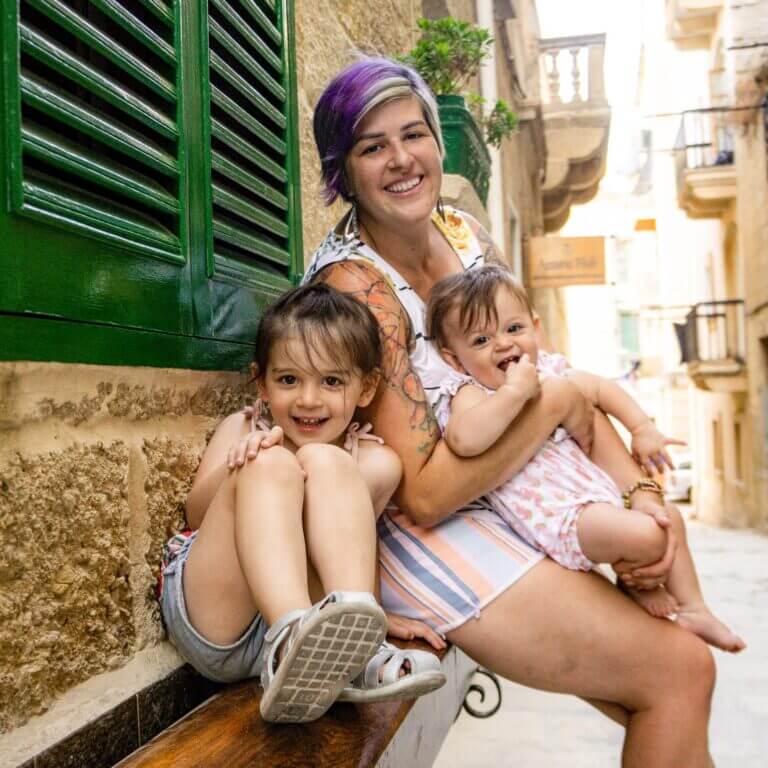

Are you getting ready to travel with your breastfed baby for the first time? Yay! It’s the best!! But you might be wondering a bit about the logistics – there is a lot to think about. Breastfeeding while traveling has some unique challenges, but it has a lot of great perks, too. I share all of my best tips (from traveling while breastfeeding many times) below!
I do not cover anything about pumping in this post, but you can click here for my favorite travel breast pumps, if that’s something that you will need as well! And let me know if you’d like me to write more about traveling and pumping in the comments. I’ve got the experience there, as well.
Breastfeeding While Flying and in the Airport
First, you should know that you are legally entitled to breastfeed while onboard any US-based airline, and most major airlines have specific policies about it listed on their websites. Those that don’t have it explicitly listed still train their flight attendants to support breastfeeding on board, although there have been occasional stories in the news when that was not the case (and those airlines took serious heat for it).
This July 2019 article from Business Insider has a good run-down of different airlines’ policies and public statements, but the main takeaway is that on any US airline (and most major international airlines as well), you’ll have no issue breastfeeding on an airplane when and however you want.
1. Take advantage of Mothers’ Rooms – or not.
Most airports have a Mothers’ Room somewhere in the airport. This is generally a cozy little room with a couple of chairs where you can nurse your baby in peace. That’s great if you happen to have one near your gate, and someone to watch all of your stuff so you don’t have to haul everything with you.

Realistically, you might be halfway across the airport from the room. Or you might be juggling multiple kids and all of their belongings. Or you might just not want to spend the time getting yourself to the special room.

There’s nothing wrong with nursing your little one while waiting at your gate. A happy, fed baby is a quiet baby! (You know, sometimes.)
If you’re not comfortable nursing while people are lining up around you, you can usually find an empty gate a lot closer than a Mothers’ Room, and set up there with some privacy.
2. Get the window seat.
Try to book the window seat if you know that you’ll be nursing during the flight. The shape of the fuselage makes it so that you have some extra room for your baby’s head in a cradle hold.
You can also turn your body away from other passengers better if you’re in the window seat, if you’re worried about that.
I would avoid the aisle seat. You’re likely to be bumped by people and carts passing by, and there is increased risk of a hot beverage spilling on your baby.
3. Nurse during take-off and landing.
This is certainly not new advice, but there is a reason everyone advises it. It really helps! In case you haven’t heard, altitude changes can hurt babies’ ears, but sucking will help their ears to pop.

Most airlines allow you to nurse your baby during take-off and landing. Many will give you a little lap belt that attaches to you and goes around the baby’s waist, but this does not interfere with nursing.
Some people prefer to have baby in the car seat during take-off and landing – that’s up to you! But if you’re holding your baby already, I highly recommend that you nurse at these times.
YOU MIGHT ALSO LIKE
4. Get help from the flight attendants.
75% of flight attendants are female (source), and you can bet that a good number of them are mothers. I have had several offer to help over many flights – things like extra blankets, warming up bottles, swinging by for service more often… they get that traveling with a baby is hard.
Don’t be afraid to ask for help if you need it. Whether it’s a blanket to use as a nursing pillow or an extra bottle of water for you, they are usually more than happy to make try to make the task easier.
You’ve probably heard of horror stories of women who have been shamed for nursing on flights. Yes, it happens. However, since so many women have taken to social media with their bad experiences, a lot of airlines world-wide have become more responsive to mothers’ needs and have trained their attendants to do so, as well.
Breastfeeding Once You Get There
5. Research cultural norms before you go.
Any time that you travel to a different country, you should respect their cultural norms. This holds true for breastfeeding. There’s going to be a difference between nursing in public in Norway versus, say, Egypt.
Knowing ahead of time will allow you to plan better. Traveling to a country where public breastfeeding is considered offensive or even illegal? Better be prepared for that! It’s only a few rare places where public breastfeeding is illegal, but there are a lot of cultures that expect you to be discreet.
Side note: it’s not always the places that you would think! We were surprised by how supportive Israel was of breastfeeding mothers, and how well I was treated while publicly breastfeeding on vacation there.
Just please don’t get yourself into a stressful situation because you didn’t know what the culture around breastfeeding was before you left. This is precisely why I include a section about breastfeeding norms in all of my destination guides – it’s information I always have to scour the internet for, and it shouldn’t be so hard to find!

6. Going somewhere warm? Expect to need more fluids.
My first trip while breastfeeding was to Thailand. We were supplementing with formula at the time – about 75% BF and 25% formula.
I counted out exactly how much formula I would need for that trip and packed it, with a little extra. Because she would usually just have 4 oz of supplement each day, I brought those super convenient little 2 oz packs. Easy and portable!
I was shocked when suddenly my daughter needed several times the usual amount of formula when we got there! Had my supply suddenly dropped? I panicked. I literally googled whether air travel impacts supply. (It doesn’t.)
After a few days, I realized what was going on. It was hot. She needed more fluids than usual, and I certainly wasn’t producing any extra to make up for it. So we went through a lot of formula on that trip, and when we returned home, we easily went back down to the usual amount of supplement.
Keep in mind that you, too, will need a lot of extra fluids! And clean water is not always easy to come by. Plan ahead for your water every day.

YOU MIGHT ALSO LIKE
7. Bring some just-in-case formula.
When we suddenly blew through our formula in Thailand, we ended up dedicating a whole afternoon to searching for formula, which was not available in the city we were in. Formula is uncommon in some cultures, so depending on where you go, it might be very hard to find.
You’ll want to have some on hand if you need it.
If you supplement regularly, bring a lot more than you think you’ll need. If you exclusively breastfeed, I really recommend that you bring some along as a back-up plan. You never know what could go wrong during travel, and if something does, you don’t want to spend your time scrambling to find an alternative way to feed your baby.
8. Plan ahead for where to nurse when possible.
If you are going somewhere like an amusement park or resort, you can think ahead about where the best places are to nurse and make a plan for staying near those areas (if you so choose!).
For example, Disney parks have a Baby Care Center. This would be an ideal place to take a break from the bustle of the park and feed peacefully. I’m not saying you should plan your whole trip around staying close to a nursing room, but it’s good to know exactly where they are when planning your day!
9. Bring a shawl or lightweight blanket.
I hate nursing covers. They’re hot, inconvenient, uncomfortable, glaringly conspicuous, and they make my baby miserable. I know some women love them, but just not me.
I absolutely live in nursing clothes, especially when traveling when we’re going to be out and about all day. Side note: I love Latched Mama and have so many of their items! There are other great brands, but they have been my go-to throughout both pregnancies.
Even so, I always bring a light muslin blanket as a just-in-case cover. Even if you’re going somewhere that completely accepts breastfeeding in public, you might need it for shade, you might end up in a situation where you’re uncomfortable – you never know. I try to always have a light blanket when I’m traveling while breastfeeding, and they always come in handy for other things as well.

10. Be aware of sunscreen.
Sunscreen + baby’s eyes = bad news. If you have sunscreen on your chest, just keep it in mind when you nurse your baby. Even if it is long-since dried, it will still run in your sweat. Your baby might also rub their hands through your sunscreen and into their eyes/mouth, so consider using a baby-safe sunscreen on yourself (I love Think Baby brand!).
And while you’re probably not applying sunscreen to your nipples (although I love the idea of nursing at a topless beach – talk about easy!), it’s not hard to imagine a baby sucking sunscreen off of your shoulders, your hands, your face… so think about what kind of sunscreen (and bug repellent, for that matter) you want to use.

Another thing to consider if you are breastfeeding on a beach or other sunny location: try to sit in the shade when you nurse! For your baby’s sake, certainly. But also for any part of your body that might be exposed that isn’t usually. You definitely don’t want to burn your tatas and then have a squirmy little baby on them afterwards!

YOU MIGHT ALSO LIKE
Other General Tips for Breastfeeding While Traveling
11. Bring a manual pump.
This is another item that you really want to have just in case. There could be any number of reasons why you might need to pump when traveling, even if you don’t regularly pump.
A manual pump is small, lightweight, and could potentially save you a lot of heartache (and engorgement). I have this Medela one and am very happy with it, but if I didn’t already own it, I would probably get something like this for travel. Remember to bring at least one bottle, too.
Even if you have brought your electric pump from home, there might be times that you are caught without power. This is more true in some parts of the world than others, of course. It’s a good back up to have.
See my favorite breast pumps for travel here.
12. Mentally prepare to breastfeed whenever and wherever.
When you’re traveling, regular schedules go out the window. The best-laid plans often fall apart. Traveling requires a good deal of flexibility, and that’s even more true when you have a baby.
You might not plan for lunchtime to occur right in the middle of your tour of the Sistine Chapel, but your baby might decide otherwise. (And hey, Pope Francis says it’s cool!) Or maybe you’re hoping to make it back to the hotel before your baby gets hungry, but you miss the bus.

Travel is unpredictable. Plan ahead as much as you can, but know that you’re going to have at least a few occasions where you’re going to nurse in a way or place that you are not prepared for. Roll with it. Feed your baby.
Breastfeeding while traveling is an interesting challenge, but it’s also great. You have food and comfort for your baby no matter where you are, you can help your child fall asleep more easily despite the chaotic schedule of travel, and you get to enjoy the bond of breastfeeding in all kinds of interesting places.
Have you breastfed your baby away from your home country? I would love to hear if your experiences have been like mine! Did this answer your questions about how to travel while breastfeeding? Let me know in the comments!
to pin for later:

Originally published February, 2019. Updated May, 2022.